UX CASE STUDY: 2026
VC LAB: ORGANIZING THE JUNK BOX. SMARTLY.
How I applied 16 years of UX expertise to architect an AI-native electronics inventory ecosystem. Evolving from a spreadsheet into SaaS Dashboard and an Android Edge Node Companion app.
00 // INDEX
01 // SUMMARY
THE SEARCH-TO-SOLDER GAP.
The modern electronics laboratory is a chaotic environment. Between microscopic SMD components, unlabeled reels of resistors, and specific M3 mechanical fasteners, traditional inventory management fails. I wondered: What if my inventory system had eyes and a brain?
VC Lab was built as a blazing-fast, locally-hosted PLM (Product Lifecycle Management) ecosystem. A
technician simply holds a component up to a camera, and the system autonomously identifies it,
categorizes it (via a strict Category > Subcategory > Sheet taxonomy), extracts its
technical specs, and files it away.
5,000+Components Modeled
<2sAI Identification Latency
60fpsVanilla JS Virtualization
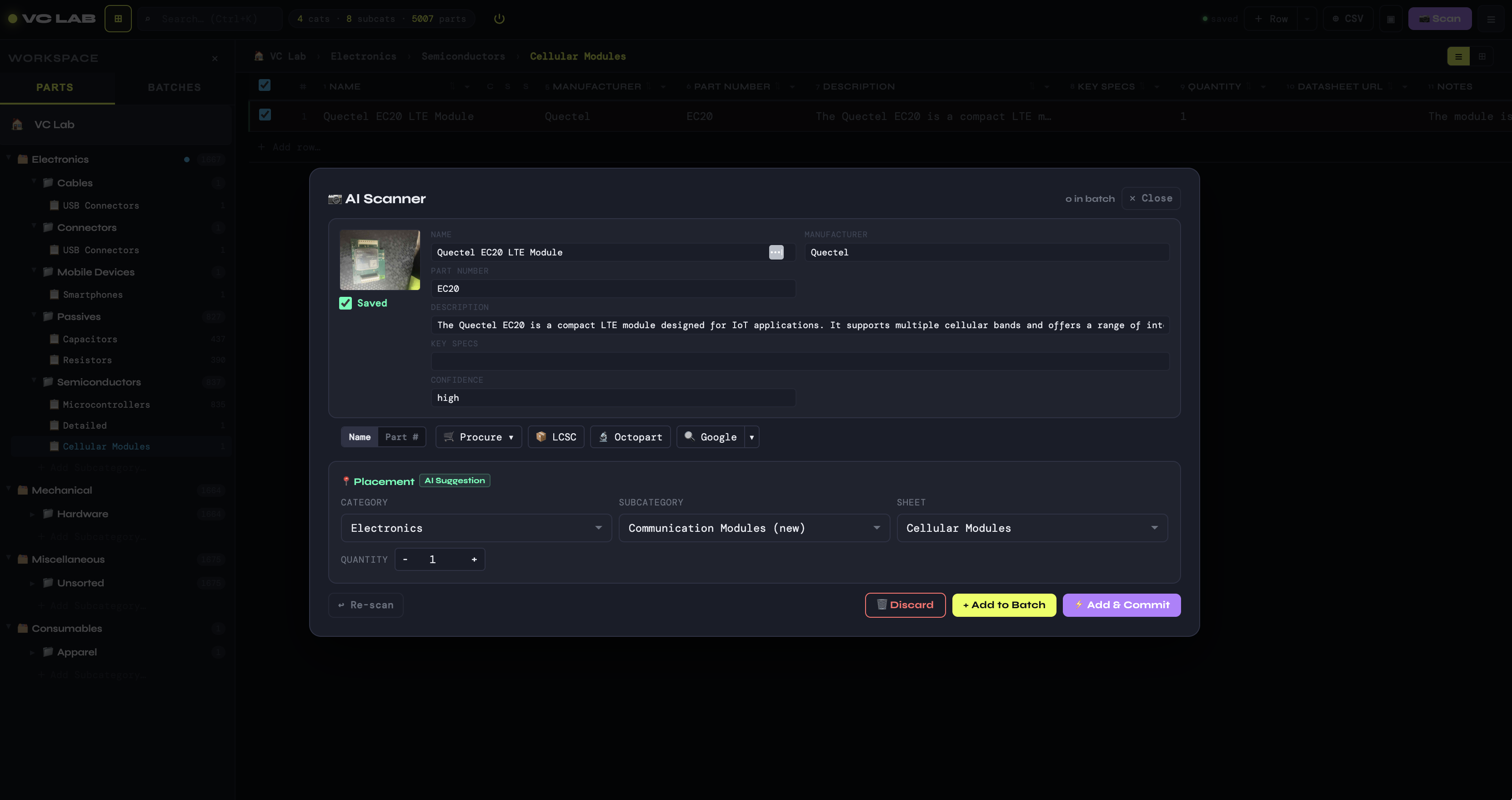
PROMPT FOR VISUALIZATION: A beautiful, sleek neon-yellow on dark grey interface
showing a grid of electronic components. Cinematic lighting, showing the speed and clarity of
the desktop app.
02 // RESEARCH
THE VOID IN THE ECOSYSTEM.
My discovery phase revealed a binary hardware market: rigid, non-intuitive enterprise systems (ERP) or fragile, manual spreadsheets (Excel) that fundamentally lack image handling and vision intelligence.
COMPETITIVE ANALYSIS
- Excel/Google Sheets: Flexible but non-relational. Data entry becomes a secondary "job," discouraging real-time usage. No native AI Vision support.
- PartKeepr: Extremely powerful relational logic but carries a high technical barrier (PHP/MySQL) and a dated, high-friction UI designed for logistics managers, not makers.
- The Pro Gap: Hardware developers often resort to expensive handheld decoders (e.g., Zebra DS2208) just to bypass poor, slow software UX.
03 // STRATEGY
DESIGNING FOR THE PROTOTYPER.
I utilized 16 years of UX intuition to map the "Prototyper Flow"—the critical transition time required from component identification to physical retrieval.
VIVEK, THE PROTOTYPER
16y UX veteran. Needs speed. Hates friction. Values aesthetic precision. Focus: Minimizing "Time-to-Part."
THE LAB ASSISTANT
Needs guided ingestion workflows. Requires the system to intelligently guess parameters to minimize data-entry paralysis.
THE UX PRD (PRODUCT REQUIREMENTS DOC)
I clustered the pain points into functional buckets that drove my technical architectural decisions:
VISION
AI ID
SQLITE
INTEGRITY
DOM
VIRTUALIZATION
DEV
SEC OPS AUTOMATION
1. EMPATHY & OBSERVATION
Shadowed typical prototyper workflows to uncover the "Time-to-Part" friction. Identified traditional Excel tracking loops as the primary velocity bottleneck.
2. RAPID VISUAL PROTOTYPING
Architected wireframes around a "One-Tap Sight" philosophy—eliminating manual keyboard entry in favor of native smartphone lens ingestion.
3. TAXONOMY ARCHITECTURE
Established a rigid semantic layout (Category > Subcategory > Sheet) to completely drastically reduce cognitive load when navigating thousands of parts.
4. HIGH-FIDELITY DEPLOYMENT
Crafted the sleek, neon-on-dark interface. Optimized specifically to reduce chromatic eye strain for technicians working in dimly lit, highly focused hardware lab environments.
THE AI-AUGMENTED "DOUBLE DIAMOND"
Design methodology isn't just about drawing wireframes; it's the architectural blueprint for solving complex problems. For VC Lab, I adopted the British Design Council's proven Double Diamond methodology, but forcefully injected it with systemic AI augmentation at every node to shatter traditional speed bottlenecks.
The Double Diamond visualizes the creative process through alternating phases of divergent thinking (exploring broadly without constraints) and convergent thinking (distilling, refining, and making concrete decisions). Building a cyber-physical system (software + hardware + IoT) inherently requires navigating massive ambiguity. The Double Diamond prevents premature optimization by forcing you to fully define the right problem before building the right solution. Hover over the phases below to explore how this applies to VC Lab:
◿ ◺
INTERACTIVE METHODOLOGY
Hover your cursor over the phases of the Double Diamond visual above to reveal the architectural decisions applied at each stage.
01. THE DISCOVER PHASE (DIVERGING)
The Core Principle: A divergent phase focused completely on exploring the problem space, gathering data, and empathizing with users without jumping directly to solutions.
The VC Lab Reality: I shadowed typical "prototyper workflows" in my own workspace. The friction wasn't purely in finding the part in a web app, but rather the "Time-to-Part" ingestion reality. An insight emerged: Data entry paralysis. If cataloging a single 10k resistor involves typing 8 different form fields into an Excel sheet, the system is doomed. I utilized AI (Notebook LM) as a sounding board to explore wild, unbounded solutions ranging from augmented reality glasses to custom mechanical dispensers.
02. THE DEFINE PHASE (CONVERGING)
The Core Principle: A convergent phase where observations are aggressively synthesized into a core insight, identifying the exact root problem to solve.
The VC Lab Reality: Notebook LM acted as my "Synthesis Engine." I fed 16
years of my UX knowledge and localized hardware constraints into it. The divergence of
ideas was violently converged into a strict Product Requirements Document (PRD). The
core thesis was locked: "Zero-friction optical ingestion. The system must use computer
vision to catalog parts instinctively." I locked the exact taxonomy
(Category > Subcategory > Sheet).
03. THE DEVELOP PHASE (DIVERGING)
The Core Principle: A second divergent phase tackling the newly defined problem. Exploring varying architectural solutions, prototyping, and iterating on code and interfaces.
The VC Lab Reality: With the exact PRD established, I explored execution options. Should it be a React SPA? A Python desktop app? A mobile PWA? I bypassed traditional Figma wireframing entirely by using Google AI Studio (Gemini 3.1 Pro) as an execution playground. When the PWA path failed the hardware camera stress test (The WebRTC ISP Blur), my divergent methodology allowed me to instantly pivot strategy to a Native Android Capacitor app without sacrificing the underlying UX logic.
04. THE DELIVER PHASE (CONVERGING)
The Core Principle: The final, ruthless convergent phase. Final testing, refining, QA, and deploying a functional product to the target physical audience.
The VC Lab Reality: We are currently traversing the late stages of Developer scaling and aggressively pushing into Deliver. The monolithic architecture has been severed into the rock-solid FastAPI Mothership and the Android Edge Node. As the ecosystem expands to physical IoT Smart Bins and the public "MoodCompute.com" launch, we will recursively loop back to micro Double-Diamonds for each epic.
04 // MOTHERSHIP
DATA PHYSICS & THE VANILLA MONOLITH.
In an era dominated by React and Virtual DOMs, I took a deliberately contrarian path: Raw Vanilla JavaScript, HTML5, and CSS3.
WHY VANILLA JS?
Frameworks introduce dependency bloat, compilation steps, and ephemeral breaking changes. By directly
manipulating the DOM natively, the UX achieves instantaneous, unthrottled render times. To handle
massive databases (50,000+ items), I engineered an inner-scroll DOM Virtualization
Engine using IntersectionObserver, keeping the browser memory footprint
microscopic by culling off-screen elements in real-time.
THE TRANSITION TO SQLITE
Initially, VC Lab utilized a massive JSON blob for storage. This introduced dangerous "Data Physics"—saving the JSON string on every minor edit caused micro-stutters and risked race-condition corruption. I executed a total sever, migrating to an ACID-compliant SQLite database via an Asynchronous Python FastAPI translation layer. A hybrid schema allows micro-transactional UPSERT delta writes for heavy specs, while keeping UI metadata sub-2KB.
Vanilla JS UI
Virtual DOM Layer
Virtual DOM Layer
FastAPI Server
Python Async Bridge
Python Async Bridge
SQLite Core
ACID Compliant
ACID Compliant
05 // SYNTHESIS
ENTER NOTEBOOK LM & AI STUDIO.
I hit a wall with standard LLM web chats—losing context, dealing with code hallucinations, and suffering from architecture drift. To scale VC Lab gracefully, I fundamentally changed how I managed AI context, embracing Systemic Knowledge Management.
NOTEBOOK LM: THE MASTER BRAIN
I uploaded 16 years of my UX design systems, mechanical logic, and my API documentation into Google Notebook LM. This became my indisputable source of truth, synthesizing my disparate rules into a cohesive architectural framework.
AI STUDIO: THE EXECUTION ENGINE (1M+ TOKENS)
With the logic solved, development shifted exclusively to Google AI Studio to leverage Gemini 3.1 Pro
via the 1M+ token context window. I fed my entire codebase natively into the prompt context
alongside a strict system_instructions.md.
- Namespace Isolation: Every prompt requires a strict prefix:
[Mothership]for Desktop or[Companion]for the Edge Mobile app, absolutely preventing code cross-contamination. - Dynamic Personas: To solve specific logic trees, I invoked personas:
WIZhandled Marlin hardware logic,NERDwrote the bulletproof Zero-Framework Python backend, andSENSEIruthlessly enforced UX simplicity. - The 5-Step Coding Protocol: I forced the AI to strictly follow an execution chain before writing code: Pre-Flight Backup -> Manual Edits -> Automation Scripts -> Rollback Scripts -> QA Validation. This kept massive Python refactors perfectly stable.
06 // MOBILITY
THE EDGE NODE: GOING NATIVE.
A lab technician cannot bring a MacBook to every hardware drawer. An "Edge Node" was required—a mobile companion app acting as a wireless scanning terminal bridging the gap to the M1 Mothership over Local Wi-Fi.
THE HARDWARE WALL (PWA ATTEMPT)
The initial app was a Progressive Web App (PWA). I hit aggressive browser limitations instantly. The
getUserMedia API treats cameras as low-latency webcams, bypassing the smartphone’s
internal Image Signal Processor (ISP). Capturing frames resulted in what I called the WebRTC
Blur: un-stabilized, non-HDR macro shots that the LVM simply could not read.
Furthermore, base64 encoding 12-megapixel arrays via single-threaded JS throttled the mobile CPU
drastically.
THE NATIVE BRIDGE: CAPACITOR.JS
To escape the browser sandbox while retaining my web codebase, I converted the architecture into a Hybrid Native Android App using Ionic Capacitor. After manually solving a brutal Gradle AGP 8.0+ ProGuard crash inside Android Studio, I had a choice:
- Option 2 (Inline Frame): Looks cool, but bypasses the phone's native post-processing. Rejected.
- Option 1 (System Camera Intent): Tapping "Scan" delegates capture to the native Android
Camera via
@capacitor/camera. Accepted. Flawless ISP-processed, crystal-clear macro photos.
The UI was redesigned into a "Card Stack Dashboard" prioritizing offline scanning (via IndexedDB) and aggressive edge-side image compression before syncing chunks back to the FastAPI Mothership.
PWA WebRTC
Friction: Lens Blur
Friction: Lens Blur
PIVOT
Capacitor Native
Hardware ISP Clarity
Hardware ISP Clarity
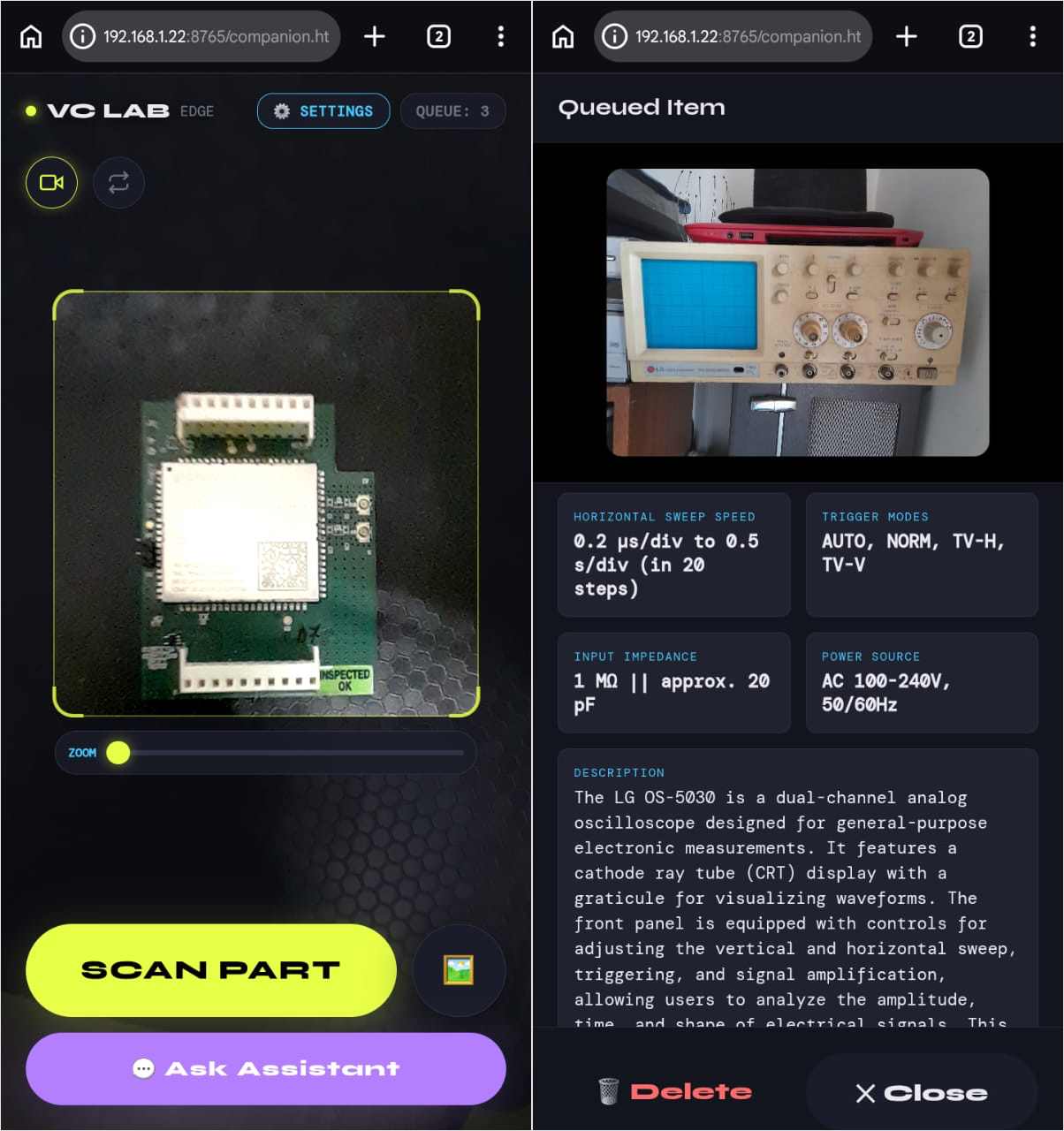
PROMPT FOR VISUALIZATION: A close-up of a modern Android phone holding a macro
shot of a complex PCB. The screen shows a neat card interface with a giant 'SCAN' button. Neon
accents.
07 // INTELLIGENCE LAYER
DATA PHYSICS & AI COGNITION.
With pristine Android images flowing in, the cognitive engine required absolutely deterministic formatting from the LLMs.
THE POLYMORPHIC PROMPT
Instead of hard-coding static columns for "Voltage" or "Thread Pitch", I instructed the Gemini API to
respond with polymorphic JSON: "Generate 5 to 10 highly detailed key-value pairs specific to
this item's domain in a 'specs' object." An M3 Screw returned mechanical traits, while an
IC returned electrical traits. My Vanilla JS iterates over Object.entries() rendering
beautiful, adaptive tables automatically.
EPHEMERAL CHAT (THE TURN-0 INJECTION)
To minimize typing friction on mobile, tapping "Ask AI" silently packages the component name, parameters, and the base64 image into a Hidden Turn-0 System Payload. The conversational chat is instantly aware of what you are holding.
THE LaTeX CRASH
Gemini loves formatting math via LaTeX delimiters (e.g., $5V$, $10\mu F$).
The raw HTML renderer choked on this syntax. I built a custom Regex interceptor inside the client to
surgically strip and re-wrap LaTeX payloads before painting the DOM, preventing catastrophic layout
shifts.
08 // DEVSECOPS
THE AUTOMATION FACTORY.
Managing a split Python Backend and Capacitor Mobile Frontend requires extreme Git discipline.
Running raw git merge commands was outlawed.
THE git_manager.py OMNI-TOOL
I engineered a dedicated CLI tool enforcing Semantic Commits (feat:, fix:,
chore:). Every time I complete an epic, the tool runs a "Scorched Earth" protocol: it
deletes all unauthorized .bak files, shreds temporary scaffolding scripts, forces the
merge, and self-checks GitHub RPC buffers (http.postBuffer) to prevent timeouts when
pushing heavy compiled Android assets.
09 // ROADMAP
ARCHITECTURAL EVOLUTION (GANTT)
The transition from a hacky Python script to a cohesive ecosystem followed a strict strategic timeline.
PHASE 0
FOUNDATION
FOUNDATION
PHASE 1
THE EDGE NODE
THE EDGE NODE
PHASE 2
AI INTEGRATIONS
AI INTEGRATIONS
PHASE 3
PHYSICAL IoT
PHYSICAL IoT
PHASE 4
COMMERCIAL
COMMERCIAL
10 // OUTCOME
THE GOLDEN MASTER v6.0.0.
VC Lab has evolved from a crude Proof-of-Concept into a stable core architecture distributed across a Desktop Mothership and an Android Edge Node. It stands as a testament to scaling a project from a niche idea into an AI-augmented, design-led engineering masterclass.
The journey forward includes Phase 3 ("Pick-to-Light" IoT hardware integration via ESP8266 WLED) and Phase 4, making the taxonomy universally agnostic and rebranding the entire architecture as V/C Base under the MoodCompute commercial umbrella.
100%
Zero-Framework Reliance
WIZ & NERD
AI Personas Utilized
Cross-Platform
Desktop / Android Ecosystem
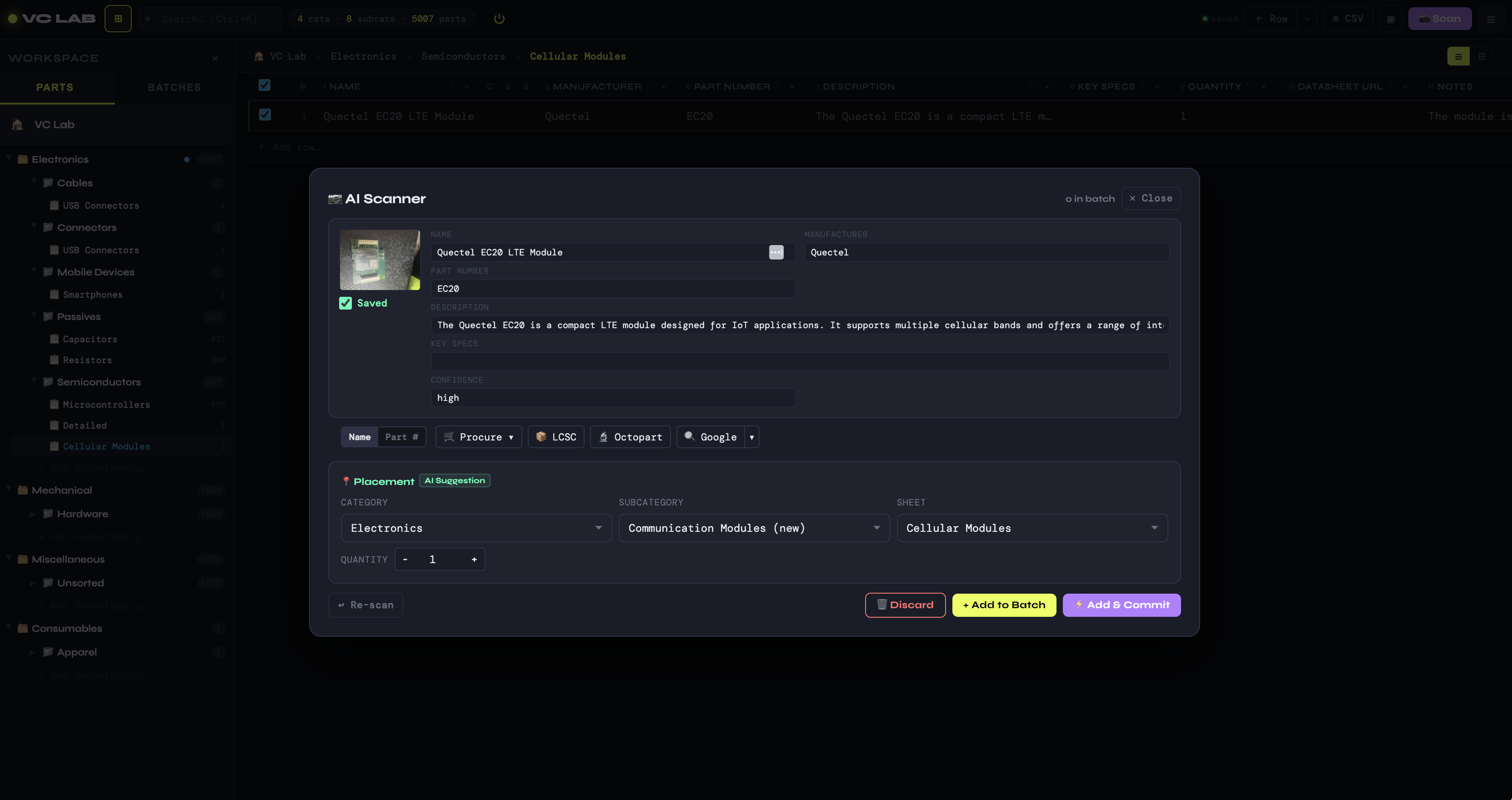
PROMPT FOR VISUALIZATION: A beautiful split-screen shot. On the left, a polished
neon-glowing v6.0 Mothership dashboard on a massive ultrawide monitor. On the right, a sleek
Android smartphone scanning an SMD microchip with neon targeting overlays. Cinematic depth of
field.